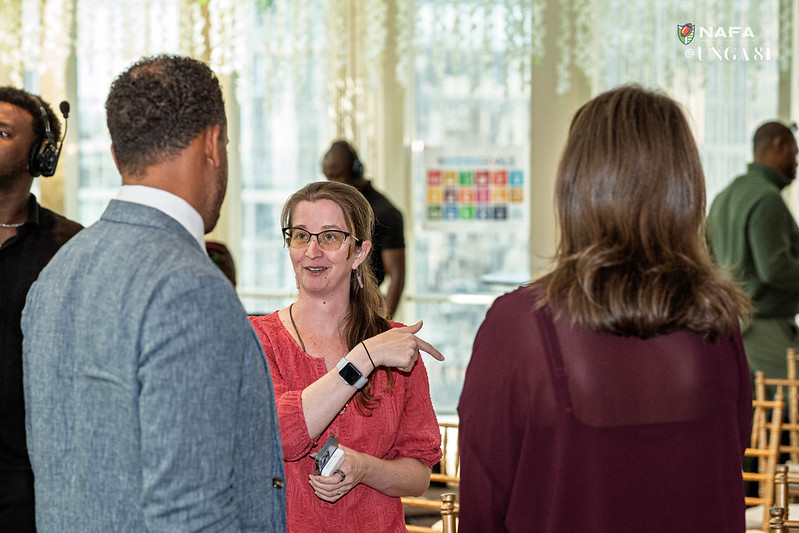
The Nigeria American Football Association (NAFA) convened nearly 60 participants, including leaders from sport, government, international development, civil society, education and the private sector in New York for “Africa Forward: Harnessing Sport for Inclusion, Youth Empowerment and Sustainable Development,” its side event during the 81st United Nations General Assembly.
Held on 21 September 2026 at Nigeria House, New York, the event placed Sport for Development at the centre of conversations around Africa’s young population, education, inclusion, skills development and sustainable development.
The event was organised by NAFA in partnership with the Cleveland Browns, NABU and the African Union Development Agency-NEPAD (AUDA-NEPAD), and in collaboration with the Permanent Mission of Nigeria to the United Nations.
The keynote address was delivered by Ambassador Martin Adamu, Deputy Permanent Representative of Nigeria to the United Nations, on behalf of H.E. Senator Jimoh F. Ibrahim, PhD (Cantab), CFR, Ambassador Extraordinary and Plenipotentiary and Permanent Representative of Nigeria to the United Nations.

In his convenor’s remarks (READ HERE), Babajide Akeredolu, Chief Executive Officer of NAFA, spoke to the organisation’s vision of using sport beyond competition, creating pathways that connect participation with education, leadership, skills development and wider opportunities for young people.
The event featured two panel discussions addressing complementary sides of the Sport for Development conversation. The first explored how structured sport can equip young people with skills and experiences that translate into education, employment, leadership and life beyond the field of play. The second examined the partnerships, institutions and resources required to build Sport for Development programmes that are sustainable, locally relevant and capable of growing beyond individual projects or funding cycles.
Across both discussions, panelists shared perspectives drawn from their respective sectors, highlighting opportunities for collaboration and the importance of translating shared ambitions into practical, lasting outcomes. The exchanges reinforced the need to connect participation in sport with meaningful opportunities for young people, while building the institutional and community partnerships necessary to sustain those opportunities.
The discussions brought together Ikenna Chris Ejimonyeugwo, Attorney, NFL Agent and Founder of RepForce Agency; Finlay Batts, Sport and Youth Mental Health Lead at the United Nations Youth Office; Sara McLaughlin, Program Officer at Laureus Sport for Good; Melissa Martin Rountree, Social Affairs Officer with the United Nations Department of Economic and Social Affairs, Division for Inclusive Social Development; Maureen Rosita Ojong, Olympism365 Manager at the International Olympic Committee; Nayeli Pozuelos, Coordinator, Cultural and International Marketing at the Cleveland Browns; and Nyiko Khoza, Head of the Africa Creatives, Sports and Recreation Programme at AUDA-NEPAD, representing Symerre Grey-Johnson, Director of Human Capital and Institutional Development at AUDA-NEPAD.

Goodwill messages were delivered by Margaret Olele, Chief Executive Officer and Executive Secretary of the American Business Council; Daniel Van Norton, Director of Football Development at the National Football League; Camille Park, Chief Executive Officer of NABU Global Inc.; and investor, strategist and cultural commentator Charmaine Hayden.
Other distinguished guests present included Ambassador Gregory Okon, former Nigerian Ambassador to Equatorial Guinea, and Her Excellency Erelu Bisi Fayemi, former First Lady of Ekiti State, Co-Founder and Chairperson of the Governing Board of Amandla Institute, and Co-Founder of the African Women’s Development Fund.
The programme also featured showcases of NAFA’s Sport for Development initiatives, audience reflections and opportunities for participating organisations and guests to connect around future collaboration.
Beyond the formal presentations, participants contributed to the dialogue through thoughtful questions, reflections and exchanges that enriched both panel discussions. Their engagement helped extend the conversation beyond the speakers’ perspectives, prompting further consideration of how sport can address barriers to inclusion, expand opportunities for young people and foster stronger collaboration among institutions and communities.
The gathering also provided a valuable opportunity for participants from different sectors to exchange ideas, build connections and explore areas of shared interest around Sport for Development in Africa.
Africa Forward linked the Sport for Development conversation to wider African and global development priorities, including Agenda 2063 and the United Nations Sustainable Development Goals, particularly in relation to young people, education, gender equality, skills development, inclusion and sustainable growth.

The discussions reflected the relevance of SDG 3 (Good Health and Well-being), SDG 4 (Quality Education), SDG 5 (Gender Equality) and SDG 17 (Partnerships for the Goals). They also aligned with Aspiration 6 of the African Union’s Agenda 2063, which envisions a people-driven Africa that harnesses the potential of its people, especially women and youth, and cares for children.
Together, these frameworks provide a wider context for understanding sport not only as recreation or competition, but as a potential contributor to inclusive and sustainable development.
Through its work across schools, universities, girls’ and women’s programmes, coaching development and international partnerships, NAFA is building pathways that use American football and flag football as tools for participation, personal development and opportunity.

The side event provided a platform to bring that experience into a broader international conversation and reinforce the role that sport can play in addressing development challenges across Africa.
With nearly 60 participants contributing to the gathering, Africa Forward demonstrated the value of bringing diverse voices into a shared conversation about the future of Sport for Development. The discussions underscored the importance of continued dialogue, cross-sector collaboration and locally grounded approaches that connect participation in sport with meaningful opportunities for Africa’s young people.